
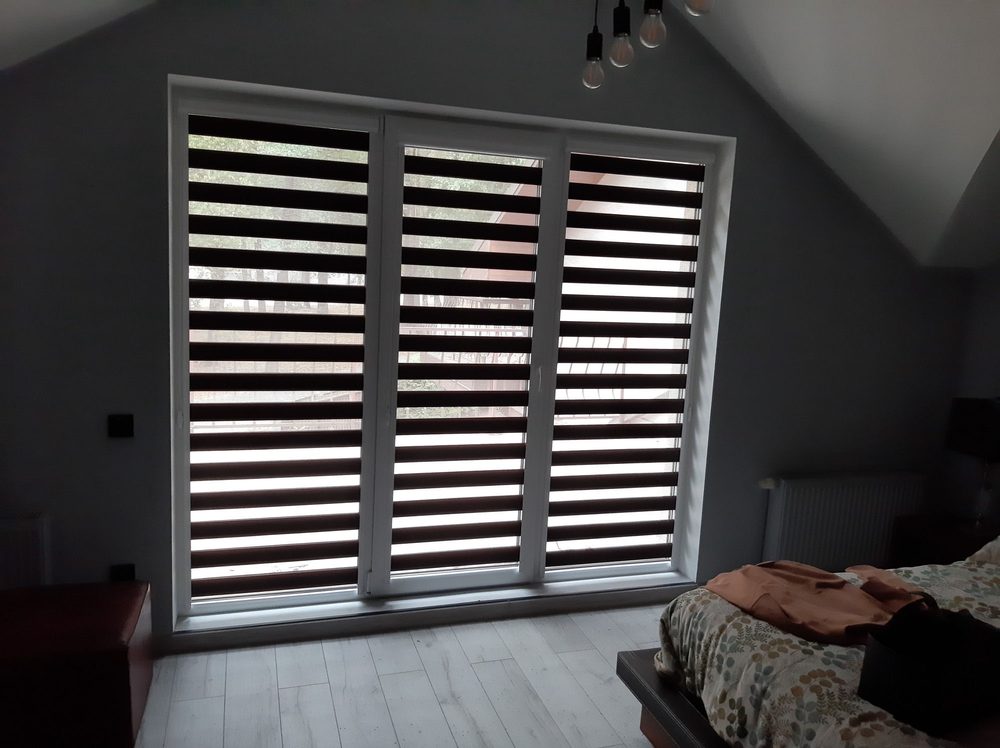
How a zebra blind works
A Day–Night roller blind — also called a zebra or duo blind — uses an ordinary roller mechanism, but the tube carries a double fabric rather than a single one: the material runs down, wraps around the bottom bar and comes back up, so two layers hang in front of the glass. Each layer alternates sheer and dense horizontal stripes. As you pull the chain, the layers shift relative to one another: the dense stripes of one layer line up opposite the sheer stripes of the other and the window "opens"; bring the dense stripes together and the room darkens. All of this happens smoothly, at any intermediate setting, without raising the blind at all.
The mechanics are the same as on a roller blind: tube, chain or motor, brackets. Only the fabric changes, which is why the Day–Night systems match the roller ones — Midi, RT, Absolute — and go in the same places: on the sash, into the reveal, on the wall or on the ceiling.
The advantages: why people love it
- Light control without raising the blind. You no longer have to choose between "up and fully exposed" and "down and dark": the stripes give dozens of intermediate settings, from a clear view of the street to a dense half-light.
- Daytime privacy. With the stripes offset, passers-by see only a mosaic while you keep the view out. For ground floors and windows facing the building next door, this is the clinching argument.
- Compactness. The Midi tube is only 25 mm: the blind fits on the sash of a PVC window, the window still tilts for ventilation and the sill stays clear.
- Choice of fabrics. The Duolight collections run to dozens of colours and densities, from light semi-transparent fabrics to dense ones, including the darkening Neroli and Nuit from 0.40 mm thick. For Day–Night fabrics and systems we have the widest choice in Latvia.
- Price. From €28/m² — not much more than a plain roller blind (from €24/m²), and one blind does the job of a net curtain and a heavy curtain together.
- Automation. The RT and Absolute systems work with Somfy and OK drives: remote control, smartphone, smart-home routines; with a motor a single blind can reach 9 m².
The drawbacks catalogues do not mention
- It will not give you total darkness. Even with the dense stripes aligned, light still creeps in along the edges of the fabric and under the bottom bar — this is a free-hanging system with no side channels. For a bedroom that has to be pitch black, you need either the cassette version or a blackout fabric paired with heavy curtains.
- A limit on width. The recommended fabric width is up to 220 cm: on wider blinds the stripes of the two layers can close unevenly. Wider openings are divided into several blinds — Multi-Link, for example, carries 2–3 fabrics on one tube — or we fit two blinds side by side.
- The stripes drift if the blind is not set up accurately. If the fabric winds on unevenly or the blind does not hang level, the stripes stop lining up over the full drop. The cure is correct installation and adjustment on site — one more argument for having it fitted professionally.
- A double layer weighs more. That is why the area limits for a zebra blind are lower than for a plain roller blind on the same tube: Midi — up to 3 m², RT 32 — up to 4 m² (6.3 with a motor), Absolute M — up to 6 m² on a chain.
- The fabric needs more care. Machine washing is out — it distorts the stripes; dry cleaning and gentle damp cleaning only (details below).
If you want the stripes and genuine darkness, take a look at Day–Night cassette blinds: the fabric runs in side channels and disappears into a headbox, so there is no light down the sides. The Uni 19, Absolute S and Absolute M systems go up to 280 × 300 cm, or up to 9 m² with a motor.
Day–Night against blackout, plain roller and cassette
| Property | Day-Night | Roller, blackout | Roller, screen | Cassette Day–Night |
|---|---|---|---|---|
| Light control | stepless, without raising | by raising only | by raising only | stepless, without raising |
| Darkening | strong, light around the edges | total through the fabric, light around the edges | no — it diffuses | strong, no light around the edges |
| View out with the blind down | yes, in the open position | no | yes, always | yes, in the open position |
| Daytime privacy | yes | yes | partly | yes |
| Maximum in a single fabric width | 280 × 300 cm, up to 9 m² with a motor | 400 × 440 cm, up to 12 m² | 400 × 440 cm, up to 12 m² | 280 × 300 cm, up to 9 m² with a motor |
| Without drilling | Midi 25/28 per sash | Midi 25/28 per sash | Midi 25/28 per sash | chosen during the measuring visit |
| Price | from 28 €/m² | from 24 €/m² | from 24 €/m² | from 34 €/m² |
The conclusion is simple: if what you want is darkness, choose blackout in a cassette; if what you want is the view and protection from heat, choose screen; and if you want flexible control of light and privacy through the day, you are in the right place.
Six Duolight systems: which one suits your window
Every system has a manufacturer’s data sheet with maximum sizes, and the calculator on the Day–Night page checks your sizes against all six at once. In brief:
- Midi 25/28 mm — the workhorse for ordinary windows and balcony doors: 30–170 cm, height up to 260 cm, up to 3 m².
- RT 32 mm — a steel tube for openings where a double fabric is already too heavy for Midi: 50–210 cm, height up to 250 cm, up to 4 m², or 6.3 m² with a motor; Multi-Link carries 2–3 fabrics on one tube.
- RT 40 mm — wide windows and picture glazing: 50–250 cm, height up to 280 cm, up to 5.5 m²; chain, crank or a 24/230 V motor.
- RT 45 mm — the strongest tube: 50–280 cm, height up to 300 cm, up to 5.5 m², or 6.5 m² with a motor.
- Absolute S — the premium option with a half cassette and system colours (white, black, grey, anthracite): 50–200 cm, height up to 240 cm, up to 4.8 m².
- Absolute M — large-format premium for full-height glazing: 50–280 cm, height up to 300 cm, up to 6 m², or up to 9 m² with a motor.
The fabric is always narrower than the overall system width: by 3.3 cm on the compact Midi and by 4.0–4.5 cm on RT and Absolute, the difference being taken up by the brackets and end caps. When the blind is mounted on the sash between the glazing beads, it is precisely this difference that decides whether a strip of light is left at the sides.
Where to fit it: bedroom, kitchen, office, nursery
Living room and study — the ideal setting: by day you control the glare on your screen, in the evening you shut out the street, and you never lose the view. Kitchen — go for denser fabrics in light colours: the stripes wipe clean easily, and marks show less on a pale fabric. Bedroom — the dense Duolight fabrics (Neroli, Nuit), or the cassette version if you need complete darkness. Nursery — the appeal of a zebra blind is that a child can set the light themselves with a single chain; we run the chain into a wall-mounted holder, and for windows children can reach a motor is the better answer. Office and meeting room — RT 40/45 or Absolute M for wide windows, motorised with group control where that helps; offices often choose zebra blinds precisely because you never have to raise the fabric to look outside.
Care: how to clean it and what to avoid
According to the Duolight specification, all Day–Night fabrics are polyester (PES), with 7.5/5 cm stripes on rolls 240–300 cm wide. Polyester does not absorb dirt and builds up little static, so it needs little care — but there are rules.
- Dust — every two to four weeks, go over the blind with a vacuum cleaner on its lowest setting with a soft brush attachment, or with a dry brush, working from top to bottom. The dense stripes lie against one another, so clean with the blind in the open position, when both layers are spread out.
- Stains — a slightly damp sponge or soft cloth with warm water, and a drop of neutral soap if needed; blot rather than rub, and never soak the fabric through. Let it dry with the blind lowered.
- Never machine wash, soak, steam or iron the fabric: the stripes and the finish distort, the fabric loses its geometry and stops lining up. Solvents and bleach are out too.
- Mechanism — once a year, check that the fabric is winding on evenly and that the chain is not skewed; if the stripes no longer meet over the full drop, the blind needs adjusting, not pulling harder.
- Wet rooms — in a kitchen with the hob next to the window, or in a bathroom, the fabric soils faster; here we will honestly point you towards aluminium venetian blinds or a washable roller fabric instead.
What to settle before you order
- Where it goes: on the sash (Midi), into the reveal or on the wall (RT, Absolute) — this determines both the size and the system.
- Whether the window opens for ventilation — if it does, we put a Midi on the sash rather than on the wall, and add side guidance where needed so the fabric stays against the glass.
- Whether you need darkness: if so, dense fabrics or the cassette version.
- A fabric width of up to 220 cm, or split into several blinds.
- Which side the chain goes (left or right), and the colour of the hardware and bottom bar to match the frame.
- A motor now, or the wiring prepared for one — retrofitting later costs more.
Manufacture takes 6–15 working days and the warranty is 2 years. Our fitter brings Duolight fabric samples to the survey: stripes are worth seeing at your own window in daylight, because photographs never convey their density and colour as accurately as the real thing.
Frequently asked questions
How do Day–Night blinds differ from ordinary roller blinds?
An ordinary roller blind has a single fabric — to see out, you have to raise it. A Day–Night blind has a double fabric of alternating sheer and dense stripes: by shifting the layers with the chain you adjust the light smoothly from a clear view to full shade without raising the blind at all. The mechanism and the systems are the same as for roller blinds.
Do zebra blinds give complete darkness?
No. With the dense stripes aligned the room darkens noticeably, but light still shows along the edges of the fabric — this is a free-hanging system. For complete darkness, choose Day–Night cassette blinds with side channels, or the densest Duolight fabrics (Neroli, Nuit) paired with heavy curtains.
Can Day–Night blinds be washed?
No: machine washing, soaking, steaming and ironing distort the stripes and the fabric finish, and the blind stops lining up. What is allowed is dry cleaning with a vacuum cleaner and a soft brush attachment, plus spot cleaning with a sponge and neutral soap, without wetting the fabric through.
What sizes do Day–Night blinds come in?
According to the Duolight data sheets, up to 280 × 300 cm in a single blind (RT 45, Absolute M), up to 6 m² on a chain and up to 9 m² with a motor. The recommended fabric width is up to 220 cm; wider openings are divided into several blinds, including Multi-Link on a single tube.
Can a Day–Night blind be fitted without drilling the window?
Yes. The compact Midi 25/28 mm system mounts straight onto the sash of a PVC window — the window still opens and tilts freely and the sill stays usable. The fitter selects the no-drill fixing during the survey: it depends on the glazing bead, the handle and the depth of the sash.
How much do Day–Night blinds cost?
From €28/m²; the exact price depends on the fabric, the system and the sizes — the calculator on the Day–Night page works it out from the manufacturer’s price list. Manufacture takes 6–15 working days, the warranty is 2 years, and installation is quoted after the survey.